PPC control
I reviewed campaigns by objective, query and product, separating exploration, defense and capture to avoid mixed readings.
Amazon Account Management · Technical Case
A technical explanation of how I connected advertising, availability, promotions and content to move from isolated adjustments to a weekly operating cadence.
01
A Daizzy Gear Amazon account worked on from March through June 2026. The archive includes Amazon Ads, inventory, promotions, A+ Content, Storefront and weekly-revenue screenshots.
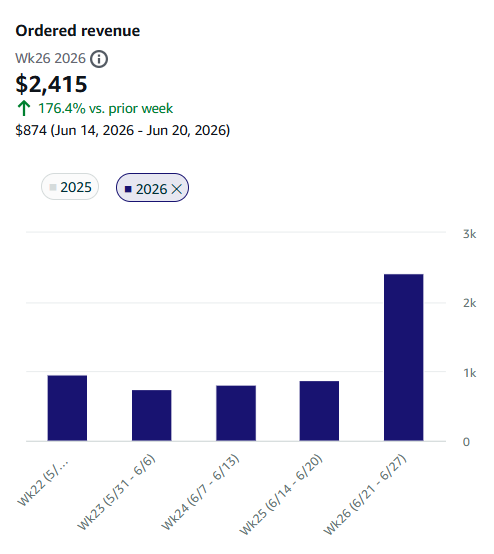
The +176.4% figure describes one weekly comparison and should not be read as sustained growth or an isolated causal result.
02
The account did not only need better bids. Performance depended on budget, stock, promotional eligibility, catalog quality and content being coordinated. Advertising a product without healthy inventory or conversion support could consume budget without creating a sustainable improvement.
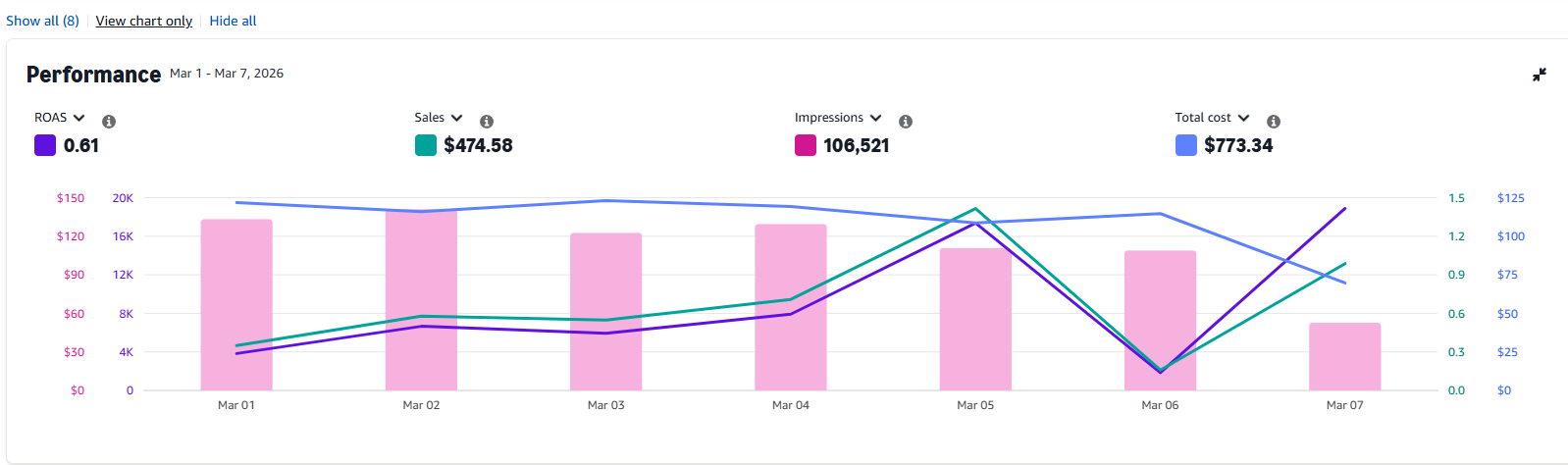
I audited media performance by campaign and product, low-efficiency signals, inventory availability and promotional readiness. The technical reading began with a March week showing 0.61 ROAS, $773.34 cost and $474.58 attributed sales, without treating that snapshot as a causal June baseline.
03
I audited and restructured PPC, defined budget-allocation criteria, coordinated promotions and content, and connected advertising decisions with inventory and catalog status. Payments, physical availability and Amazon approvals remained with the brand and platform.
04
I reviewed campaigns by objective, query and product, separating exploration, defense and capture to avoid mixed readings.
I defined where to sustain, reduce or scale investment based on margin, stock, history and conversion capacity.
I coordinated promotions, coupons and Prime support with availability and the need to clear aging inventory.
I implemented A+ Content, Storefront and catalog improvements so advertising landed on a coherent experience.
I organized a repeatable review of performance, inventory, issues and next moves.
TECHNICAL NOTE
Decisions were connected across four operating layers; these are the criteria applied.
Optimization happened at campaign, term and product level. The goal was not uniformly lowering ACOS, but assigning each campaign a function: discovery, capture, defense or promotional support.
I analyzed spend without sales, queries showing conversion signal and overlap across campaigns. Negatives and bid changes directed traffic instead of acting as automatic cleanup.
Before scaling, I checked availability and stockout risk. Budget had to favor products able to capture demand without accelerating constrained references.
Coupons and discounts were planned by objective: event capture, conversion support or aging-inventory clearance. A promotion without stock, margin or suitable traffic was incomplete.
I updated modules, comparisons and visual support to clarify product differences and reinforce campaigns. Content acted as conversion infrastructure rather than decoration.
I included eligibility, variations, product information and account issues because these blockers can invalidate a sound advertising strategy.
EVIDENCE
05
Weekly ordered revenue moved from $874 to $2,415 between June 14–20 and June 21–27, 2026. The +176.4% figure documents one week-over-week recovery; it is not presented as sustained growth or the isolated causal effect of one tactic.
Source: Amazon Seller Central — image_076.png; Amazon Ads — image_048.png
06
Technical Amazon management means optimizing constraints, not only campaigns. The best advertising decision may be to wait until stock, catalog, margin or content is fixed; and the best content improvement may fail if traffic does not match intent.
Next step
I can audit PPC, inventory, promotions and content as a weekly operating system with explicit decisions and limits.