A sporting life built from connected decisions.
Predestinato began with a personal question: how could I turn everything that attracts me to motorsport into a game where every decision builds a different career? The result starts in karting, opens routes into single-seaters, touring cars, rally and endurance racing, and connects performance, money, reputation, contracts and risk all the way to retirement.

The career is not a single ladder toward Formula 1.
The market mixes renewals, formula categories and alternatives in touring cars, rally or endurance. Players can build a valid path without reaching F1, change disciplines later in life or leave motorsport after mismanaging the economy.
Five statistics and Form
Speed, pace, consistency, stamina and aggression evolve through training, age and decisions. Temporary Form ranges from −5 to +5.
Pay, earn and negotiate
Karting requires investment; professional categories introduce salaries and bonuses. Sponsors, staff, the store and contracts compete for the same capital.
Markets with alternatives
F4, Regional, F3, F2 and F1 coexist with TCR, rally, GT4, LMP3, WEC, IndyCar and other fictional destinations adapted to progress.
Identity is already a game decision.
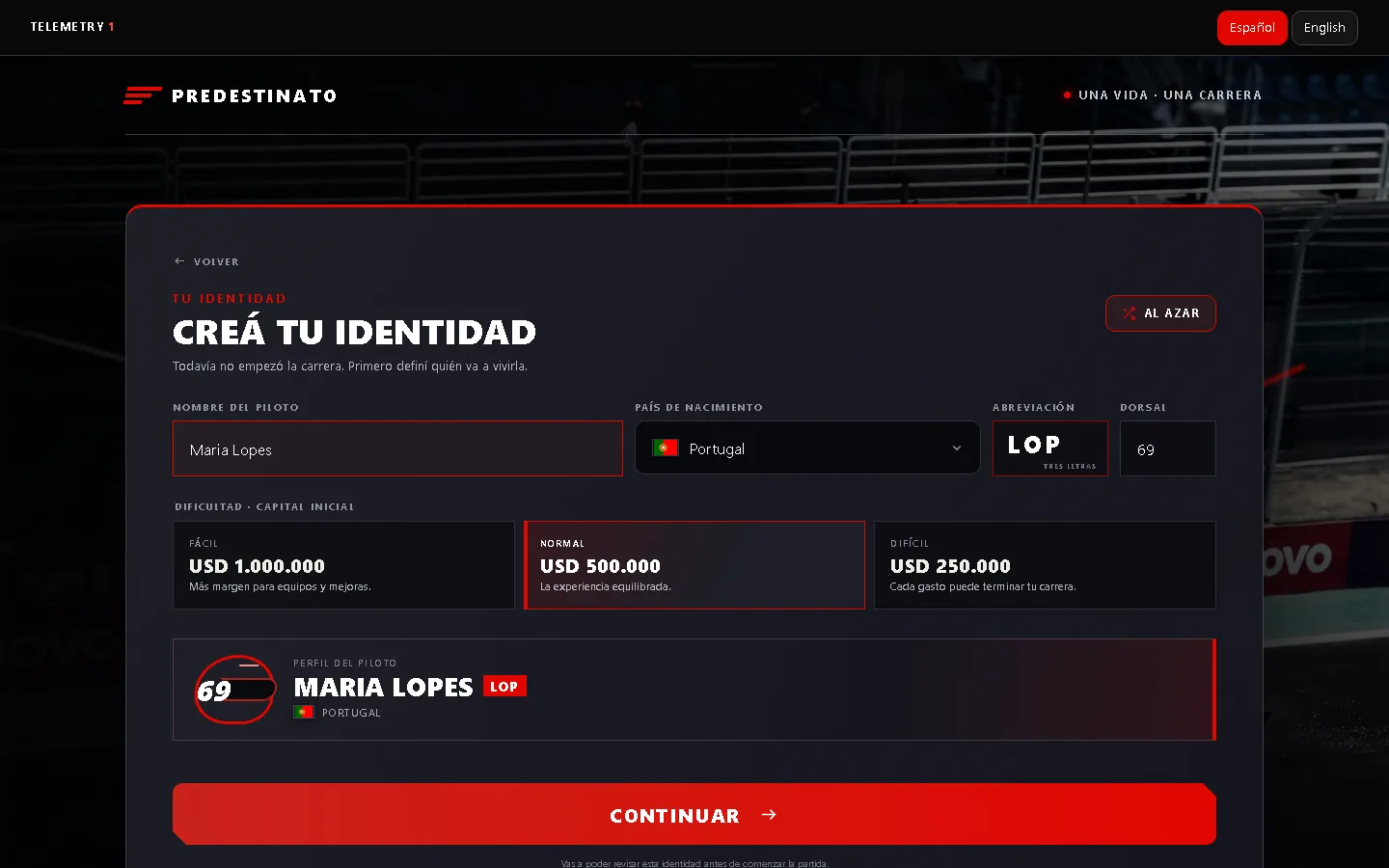
The opening flow asks for name, country, abbreviation, race number and economic difficulty. They are not isolated fields: they feed the driver presentation, regional offers, interface identity and financial margin for error.
Three offers, not one correct answer
The opening market presents random regional teams and different investment levels. The aim is not to find “the best,” but to accept a combination of cost, opportunity and risk.
A visible curve
Difficulty changes the starting capital. The interface shows the consequence before play begins so financial failure becomes an understandable decision rather than a hidden surprise.
Every season changes the next one.
Preseason card
A decision changes permanent or temporary attributes, capital or risk. The deck contains 70 normal, 20 rare and 10 golden cards.
Short agenda
A season contains between one and three interactions to preserve pace: narrative decisions, challenges and special events.
Result and settlement
Position, wins and points activate bonuses, sponsors, fame, market value and the contractual close.
Market and development
Age, Form, category and performance change offers, duration, salary and the possible routes for the following year.
Detail matters when it changes the strategy.
Three-year rolling window
F1 requires 40 points, a minimum age and eligible seasons. The HUD shows which requirement is missing and avoids an invisible barrier.
Seven points per season
Each point adds 0.2 internally. Decimals are preserved in calculations even when the main panel shows rounded values.
Development, prime and decline
The curve accelerates during development, sustains a base prime and then concentrates decline in stamina, pace and aggression.
Cumulative protection
Investing in physical care early can extend the prime by up to three seasons and reduce a stamina decline.
Budget and patience
Counteroffers connect fixed pay, bonus, duration and demands. Three rejections end the negotiation.
Achievements across disciplines
Monaco, Indianapolis, Le Mans, Monte Carlo and Dakar feed independent collections of wins and championships.
Simulating complete careers to improve the design.
The audit combined browser tests with 270 seeded careers—three difficulties, three starting-cost levels, three skill profiles and ten seeds—and produced 8,825 completed seasons.
| Difficulty | Careers | Reached retirement | Financial elimination | Reached F1 |
|---|---|---|---|---|
| Easy | 90 | 90 | 0 | 59 |
| Normal | 90 | 80 | 10 | 58 |
| Hard | 90 | 8 | 82 | 8 |
Those simulations made balance observable: they helped tune economy and progression while detecting mixed grids, rivals who did not age, impossible win totals and duplicated contract states. Designing the game also meant building tools to understand how it behaves.
Translate a complete sporting career into states the game can remember.
Development began by separating identity, performance, economy, contract, calendar and achievements. Each module changes one part of the career while all of them read a shared driver state. That architecture lets a preseason card affect a future negotiation, age change the value of training and a win update fame, money, market position and collections at the same time.
The annual loop works as a state machine. A season starts with preparation, opens a short agenda of decisions or minigames, simulates the result, settles bonuses and costs, updates progression and finally builds the next market. Saving every transition makes errors inspectable and prevents the same reward from being applied twice.
Content was also designed as a system. Cards share a structure for rarity, condition and effect; categories describe costs, prizes and requirements; fictional teams are grouped by region and level; minigames return outcomes that the main engine can compare. Adding content does not require inventing new logic for every screen.
Model state
Define what the career remembers and which variables change through age, decisions, results or contracts.
Build content
Express cards, categories, teams and events through reusable structures and shared rules.
Resolve the season
Process interactions, performance, economy and market in an order that preserves consistent consequences.
Persist and audit
Save transitions and seed simulations so a problematic career can be reproduced exactly.
Depth appears when simple systems begin pushing against one another.
A decision becomes interesting when it cannot improve everything at once. Investing in training can reduce financial margin; accepting a safe contract can close a sporting route; pursuing a harder category adds prestige and risk; paying for physical care early sacrifices present capital to extend future performance. The design connects those tensions so every career tells a different story.
Few visible decisions
One to three interactions per season keep progress fast while consequences accumulate over decades.
One resource, several destinations
Entry fees, staff, store, physiotherapy and negotiation compete for capital and turn the budget into strategy.
A curve with stages
Development, prime and decline change the value of training and make every investment depend on age.
Offers with context
Category, Form, performance and region build different options instead of an automatic ladder.
Rules players can read
The HUD exposes requirements, attribute changes and financial consequences so players can learn the system.
Reproducible stories
Seeds turn a strange career into a case that can be replayed, fixed and checked again.
A system ready to keep growing.
- Persistent careers: saves can turn each path into a story that can be resumed, shared and compared.
- More ways to play: alternative inputs and an assisted mode can broaden access to the 16 minigames.
- Adaptable balance: simulation data makes it possible to refine the economy and define each difficulty’s intended experience.
- Sporting history: a race-by-race record can turn results, contracts and rivalries into a browsable biography.
- An original universe: teams, contracts, amounts and results form a motorsport fiction that can grow without losing systemic coherence.