Why fitment campaigns lag the account.
32 vehicle-fitment campaigns returned less than half the account's ROAS. Most of the gap came from two oversized budgets and an exhausted account cap, not from the idea itself.
Matías Gaglio ·
Leer en español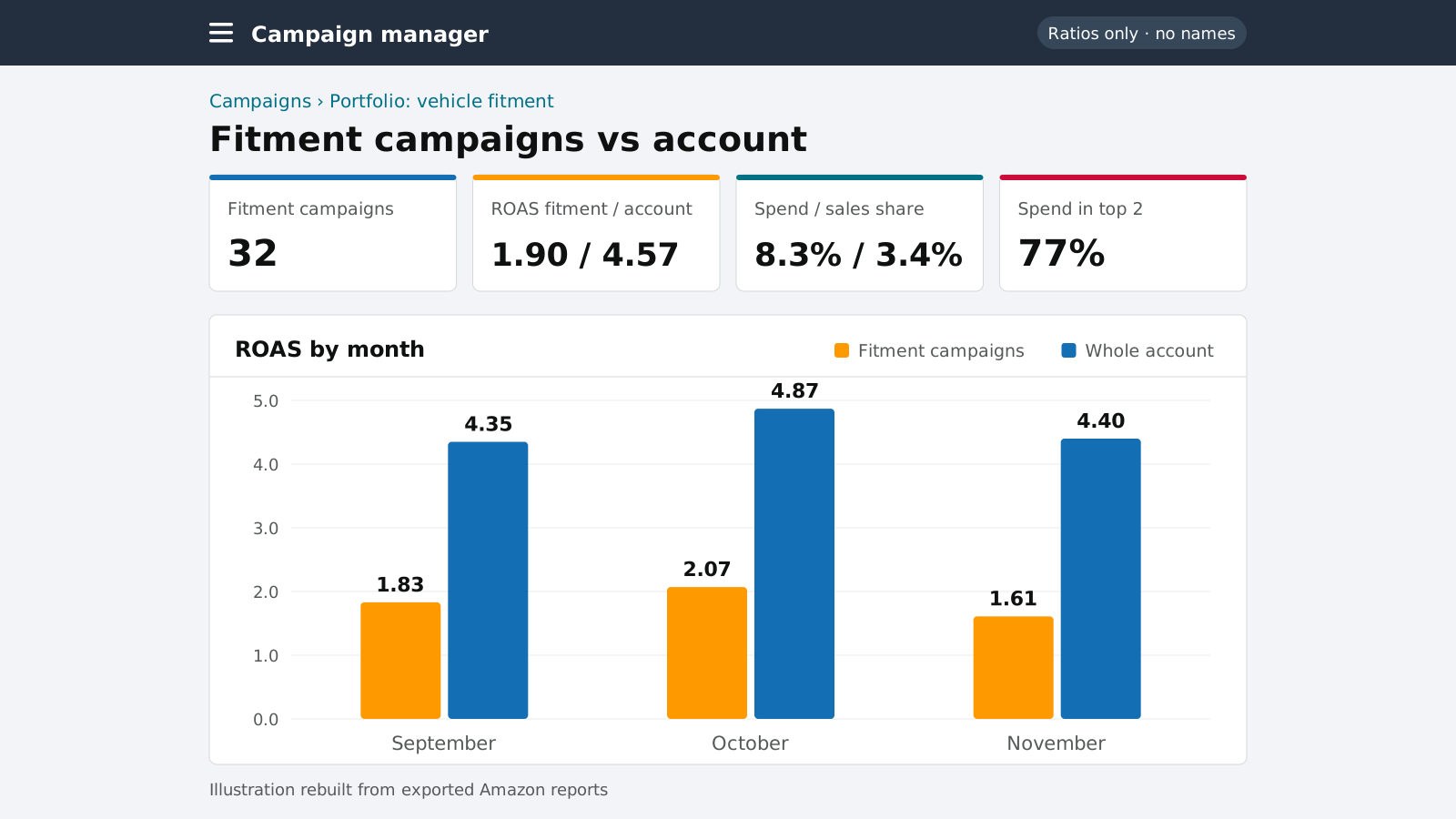
Target the vehicle, not just the part.
Wheel accessories are bought for a specific vehicle. A shopper rarely searches "lug nuts". They search for lug nuts for their truck, with its thread size and lug count. Fitment campaigns follow that logic: Sponsored Products and Sponsored Brands campaigns built around vehicle-fitment searches, with Brands campaigns sending traffic to collections of the parts that fit.
From September the team launched 32 of them from a backlog of fitment tasks in Asana. Ten weeks later I pulled every campaign with "Fitment" in its name and compared it to the rest of the account.
Less than half the account's ROAS.
Since September the fitment set has returned 1.90 ROAS against 4.57 for the account. It took 8.3% of ad spend and brought back 3.4% of ad-attributed sales. The gap held every month, so this isn't a single bad week.
| Month | Fitment ROAS | Account ROAS | Gap |
|---|---|---|---|
| September | 1.83 | 4.35 | −58% |
| October | 2.07 | 4.87 | −57% |
| November 1–10 | 1.61 | 4.40 | −63% |
Two campaigns were most of the problem.
77% of spend in 2 campaigns
Two Sponsored Brands campaigns, one for spike lug nuts and one for another lug nut line, took 77% of fitment spend at 2.33 and 1.12 ROAS. The other 30 campaigns returned 2.01.
12 campaigns, 0 orders
A dozen campaigns spent with no sales at all. A single exact-match campaign accounted for about 70% of that waste.
7 never spent
Seven campaigns never delivered, most likely because the Sponsored Products account cap was already exhausted by older campaigns.
Seen this way, "fitment doesn't work" is the wrong conclusion. Sponsored Brands carried the bulk of the spend and the loss (8 campaigns, 1.91 ROAS), and two oversized budgets set the average. Sponsored Products fitment campaigns spent little, and many were too young to judge either way.
Age before verdict.
The same ROAS bands used for the rest of the account apply here, age gate included. Run through them, the 32 campaigns split like this:
- 12 under 30 days old: leave alone, whatever the ROAS.
- 7 with no spend: check the account cap before blaming the campaign.
- 6 to cut 35 to 40%, including the two big Sponsored Brands budgets.
- 5 to pause, all below 1.5 after enough time to judge.
- 2 to scale: small exact-match campaigns at 7.5 and 21.8 ROAS.
The promising ones are young
A few recent campaigns are already above the account average, between 4.2 and 4.6 ROAS, and the November Sponsored Brands collections had early single orders at 6.8 to 14 ROAS. None of them have 30 days of data yet, so they stay as tests.
Launch fitment campaigns small and evenly.
The fitment idea is sound, because buyers really do search by vehicle. What hurt was the rollout. Two campaigns got big budgets before they had proved anything, and the smaller ones competed for an account cap that was already full. Next time I'd launch fitment campaigns with equal small budgets, add negatives from the first search term report, and only give more budget to the ones that clear the account average after 30 days.